
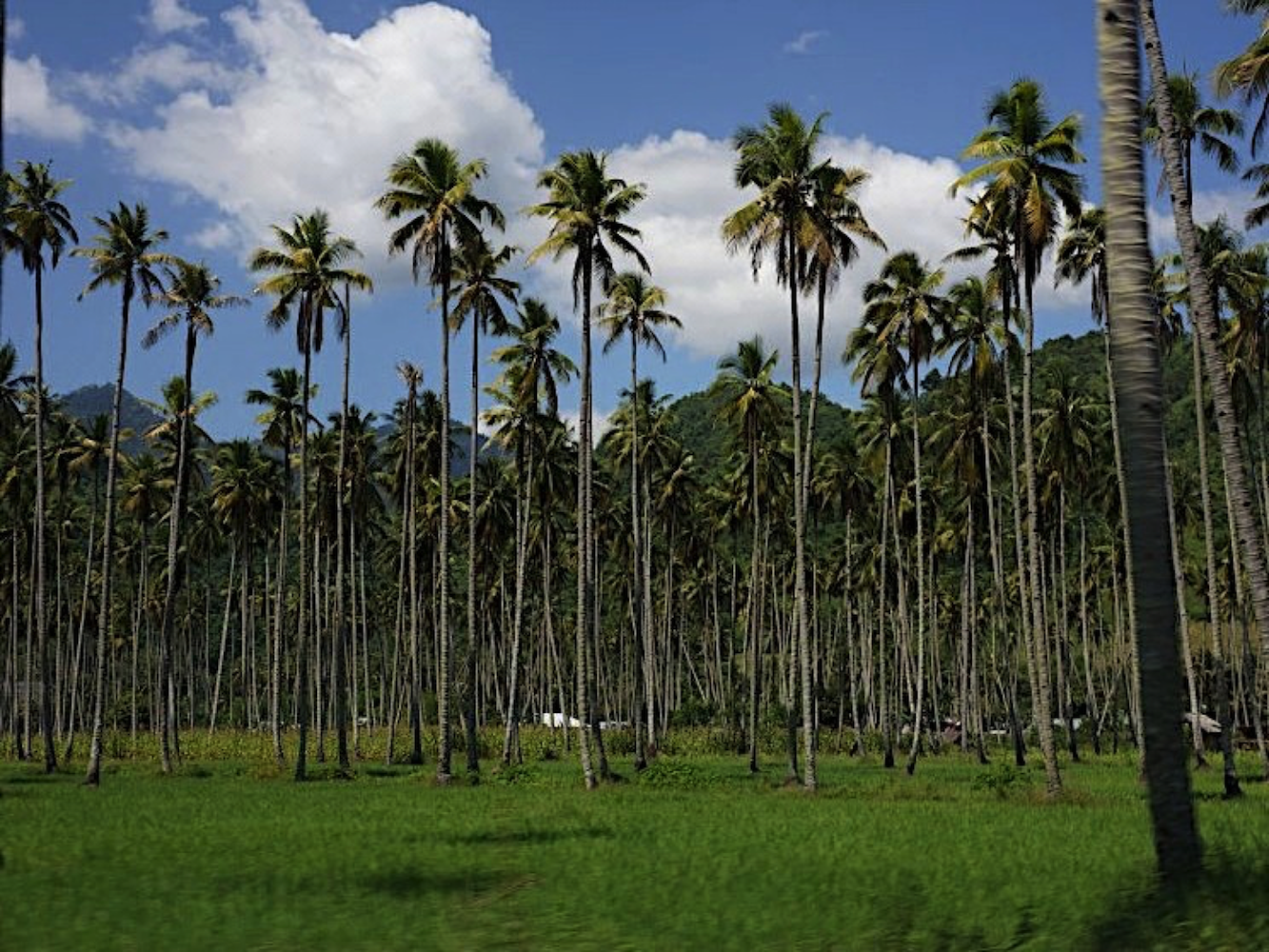
In Indonesia—the world’s largest archipelago and one of the top coconut producers globally—the coconut palm is often called pohon kehidupan (the tree of life). From its roots to its crown, nearly every part serves a purpose: food, fuel, shelter, and income. But beyond the idyllic image of sunlit groves lies a sophisticated, often invisible network that connects a farmer’s daily labor to supermarket shelves thousands of kilometers away.
Let’s trace the journey of a single coconut—harvested on a small family farm in rural Indonesia—on its path to a foreign port in Europe.
Stage 1: The Harvest – A Farmer’s Dawn
The journey begins before sunrise. On a modest plot, a farmer inspects his palms, listening for the telltale hollow sound that signals ripeness. With practiced precision, he uses a long bamboo pole fitted with a curved blade—or climbs the trunk itself—to harvest mature coconuts, taking care not to harm the tree or future yields.
Most coconut farms in Indonesia are smallholdings, averaging just 1–2 hectares. These farms account for over 90% of national production and represent the livelihoods of millions of rural families. Each palm may yield 60–100 nuts per year, depending on age, soil health, and seasonal conditions.
The harvested coconuts—still encased in their thick, fibrous husks—are gathered and transported by handcart, motorbike, or small truck to a nearby collection point, often run by a local cooperative or village-based aggregator.
Stage 2: Village-Level Processing – Hands That Shape Quality
At the collection center, women and men work side by side in open-air sheds, removing husks by hand using machetes or simple mechanical dehuskers. This step is both art and science: too much force can crack the shell; too little leaves excess fiber.
The husks—valuable in their own right—are often set aside for local use (as garden mulch or craft material) or sold to coir processors for eco-friendly products like erosion mats and biodegradable pots.
The de-husked nuts are then sorted by size, weight, and visual quality. Only firm, symmetrical coconuts with unblemished shells are selected for export. Others are diverted to local markets or processing units to become coconut milk, oil, flour, or sweeteners.
Within a day of harvest, the top-grade coconuts are packed into breathable sacks or crates and loaded onto refrigerated trucks—beginning the next leg of their journey.
Stage 3: Central Processing & Certification – Meeting Global Standards
At a certified processing facility—often located near a major transportation hub—the coconuts undergo rigorous quality assurance. They are washed, sanitized in food-grade solutions, and inspected for internal defects using non-invasive methods (e.g., sound testing or X-ray scanning).
Documentation is key. Each batch must be accompanied by:
- A phytosanitary certificate (ensuring freedom from pests and disease),
- Traceability records (harvest date, farm ID, handler information),
- And, increasingly, sustainability certifications (such as Organic, Fair Trade, or Indonesia’s national sustainable agriculture standards).
Some facilities now embed QR codes or NFC tags in packaging—allowing importers and end consumers to verify origin and ethical sourcing with a simple scan.
Coconuts bound for the fresh fruit market remain whole and chilled (12–15°C) to preserve freshness, delay sprouting, and extend shelf life. This cold chain is maintained from processing through loading to prevent spoilage during transit.
Stage 4: Export Logistics – To the Seaport
Containers of coconuts join other high-value agricultural exports—like coffee, spices, and tropical fruits—at one of Indonesia’s major international ports. Logistics teams coordinate with shipping lines, customs brokers, and inspection agencies to ensure compliance with destination-country regulations.
Thanks to modernized port infrastructure and digital customs systems, clearance times have improved significantly. Under trade agreements like the Indonesia–EU Comprehensive Economic Partnership Agreement (CEPA), many agricultural exports—including coconuts—now enter European markets duty-free, incentivizing quality upgrades and traceability investments.
Our coconut is loaded into a refrigerated container aboard a cargo vessel bound for Europe. The ship embarks on a voyage spanning more than 10,000 nautical miles—crossing equatorial waters, navigating vital maritime corridors, and, in many cases, passing through the Suez Canal.
Stage 5: Arrival Abroad – Customs, Distribution, and Shelf
After roughly four to five weeks at sea, the vessel arrives at a major European port—perhaps Rotterdam, Hamburg, or Antwerp. EU border control carries out risk-based inspections: verifying documentation, sampling for pests, and confirming temperature logs.
Once cleared, the container is transferred to a regional distribution center. From there, coconuts are delivered to wholesalers, organic retailers, or specialty food importers. Within days, our coconut rests on a produce display in a city supermarket—its shell still bearing the faint scars of harvest, its water cool and sweet.
A shopper picks it up, curious. She scans the label:
Origin: Indonesia | Harvested: Early November 2025 | Grown by Smallholder Farmers | Sustainably Sourced.
She smiles—not just buying a fruit, but a story.
Looking Ahead: Roots and Resilience
Despite its abundance, Indonesia’s coconut sector faces real challenges: aging tree populations, fragmented post-harvest systems, and the need for greater investment in high-yielding, disease-resistant varieties. Climate variability—unpredictable rains, prolonged droughts—also tests the resilience of farming communities.
Yet the future holds promise. Farmer cooperatives are gaining strength. Digital tools—mobile apps for market prices, satellite-assisted advisories, and e-certification platforms—are reaching rural areas. And global consumers are increasingly willing to pay a premium for transparency, fairness, and sustainability.
In this context, the coconut is more than a commodity. It’s a vehicle for rural development, ecological stewardship, and cross-cultural connection.
Final Thought:
The next time you hold a coconut—whether cracking it open for water, grating its flesh, or simply admiring its symmetry—remember: it has traveled not just across oceans, but through generations of knowledge, care, and hope. Its journey, from an Indonesian farm to a foreign port, is a quiet testament to the power of small things, done well.